CwX Denmark: Her mødes mennesker og regnskabsbranchen
Read more
Sharing Caseware’s AI Journey
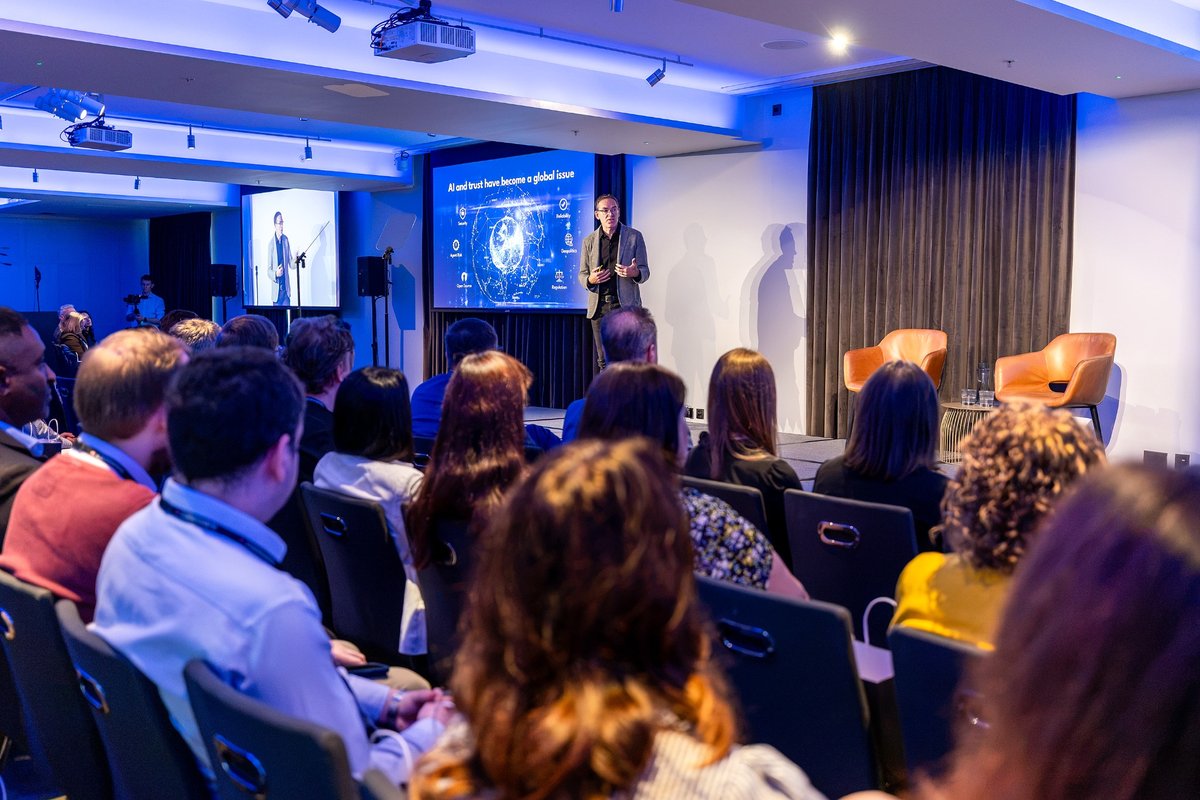
Recently, Anthropic asked me to present Caseware’s experience to approximately 50 fellow CEOs in New York. They asked us to share the progress behind our Caseware Verity launch, our internal AI transformation, and our speed of execution across the organization.
Being selected by one of the world’s leading AI companies to showcase Caseware as a leading example of AI transformation was a real honour and recognition of our team’s ambition, creativity and execution.
The question behind the invitation was one many leaders are considering: what has enabled Caseware to move quickly and decisively as an AI-first company, while others are working through the challenges of internal transformation and customer-facing innovation?
Bringing Agentic AI into Our Customers’ Workflows
Our mission at Caseware is powering trust in the global economy. AI expands how we serve that mission, helping accounting and assurance professionals work more efficiently while keeping their judgment central.
In May, we launched Caseware Verity, bringing engagement-aware AI directly into customers’ workflows. Caseware Verity combines frontier intelligence with engagement evidence, firm methodology and professional context. It is delivering approximately 80% time savings on selected audit tasks.
We followed the launch with our Agentic Pioneer Program, through which firms help shape and develop agentic capabilities on our governed platform.
Our advantage comes from bringing these capabilities into the trusted system of record where assurance work already happens, giving customers a foundation for their AI adoption journey.
Transforming Product and Engineering with Agentic AI
Helping customers transform requires us to embrace the same changes ourselves. Nowhere is that more visible than in Product and Engineering.
Compared with this time last year, these teams operate in a fundamentally different way. We have redesigned delivery around agentic pods, integrating agents across development, code review, testing and deployment. Engineers increasingly direct and evaluate agentic work, supported by quality and production checkpoints.
Product experts rapidly develop working prototypes and refine them with customers. Our subject-matter experts, including former auditors, are building and testing agents themselves. Their professional expertise can become working software much faster.
The transformation extends beyond coding. Teams are changing how they define problems, prepare context, collaborate and review results. Traditional role boundaries are evolving as more people gain the ability to build.
Engineering teams are delivering twice as many pull requests per engineer and deploying four times as frequently. We are channeling that increased capacity into developing and bringing more agentic offerings and improvements to customers.
Innovation Is Emerging Across the Company
Today, 97% of our employees have access to approved AI tools, with most licensed enterprise-tool users active weekly. That broad access creates the foundation; the deeper change comes as people rethink their work.
Innovation is emerging across Finance, Sales, Marketing, Customer Success, Security and People Operations. People without Product or Engineering backgrounds are building solutions, reducing manual effort and expanding their teams’ capabilities.
Progress is exciting but uneven. People discover possibilities at different speeds. Our task is to support that learning and spread effective practices, with shared objectives: move faster, improve efficiency and create capabilities that previously felt out of reach.
The Playbook: Urgency, Ownership and Outcomes
Caseware had been investing in AI for years. As coding models and agentic capabilities improved, particularly in the second half of 2025, the opportunity changed materially. The technology was ready for more ambitious work, the industry was shifting, and we had a foundation to build on.
We made a deliberate leadership choice to accelerate. R&D offered a clear starting point, while our strategy made AI everyone’s responsibility.
Each functional leader owns an AI plan on a page: objectives, priority use cases, investment and intended outcomes. Specific use cases tether spending to business results. Shared governance provides oversight of tools, budgets, usage, security and risk.
Leaders must engage personally: use the technology, question established practices and take ownership of redesigning their functions. Teams need support and room to experiment, alongside accountability for results.
We learned through execution. Early successes increased confidence, encouraged more ambitious applications and created momentum. Better capabilities and better ways of working reinforced each other.
What Fellow CEOs Wanted to Understand
The questions afterward focused on execution. How did we accelerate R&D? How do we assess returns? How do we bring leaders and teams along, particularly when adoption is uneven?
My answer was that progress required a combination: a foundation to build on, a clear commitment to change, leaders who leaned in, and specific work around which teams could learn and demonstrate results.
That remains demanding. We are transforming while running the business, adapting as capabilities evolve and helping employees move along different learning curves.
Our next challenge is making individual breakthroughs repeatable across teams. That experience also strengthens how we support accounting firms navigating their own changes in people, processes and professional work.
I left proud of our team and energized by what comes next. Our mission remains powering trust in the global economy. Being AI-first is expanding what we can deliver to that mission and how quickly we can deliver it.