
Using the directDART Additional Data Source
We strongly recommend importing the Data Requests provided in the DataSources\directDART\DataRequest folder and using them as templates because the interdependencies between the segments and filter definitions have already been set for these Data Requests.
Each of the pre-defined Data Request templates contains a descriptive text with important information, e.g. on the filter values to be entered.
The directDART Additional Data Source provides segment definitions based on DART.
For the extraction in the DART segment format the SmartExporter Data Dictionary provides segments which are shown as tables of the type structure. In the Select Tables step of the SmartExporter Create Data Request wizard you can search your Data Dictionary for tables of the directDART Additional Data Source by entering the term "DART" into the search field.
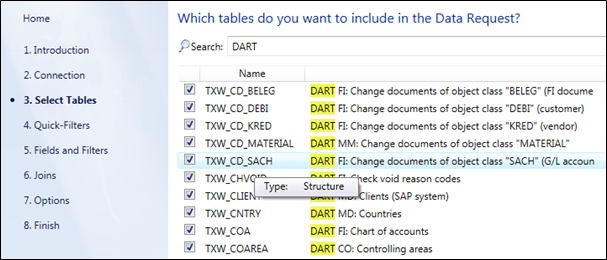
Note:
If the tables are not displayed, please check in the application options in SmartExporter whether the correct Data Dictionary has been selected.
The SAP Components\DataSources\directDART\DataRequest folder contains the following Data Requests which you can import in SmartExporter:
-
directDART - BEA-Modell version 1.0 as of 23 March 2022
This Data Request template is based on a document as of June 2015 containing specifications for the data carrier cession for SAP® systems in which the Data Retention Tool (DART) is used. (German document title: "Datenanforderung für die Datenträgerüberlassung aus einem SAP-System bei Nutzung des Data Retention Tools (DART) (bundeseinheitlich abgestimmt) Version 1.0 Stand Juni 2015”)
-
directDART - BEA-Modell version 1.1 as of 23 March 2022
This Data Request template is based on a document of the German fiscal administration as of June 2019 containing specifications for the data carrier cession for SAP® systems in which the Data Retention Tool (DART) is used. (German document: “Bundeseinheitlich abgestimmte Datenanforderung für die Datenträgerüberlassung aus einem SAP-System bei Nutzung des Data Retention Tools (DART) (“BEA-Modell“), version 1.1 as of June 2019))
-
directDART - BEA-Modell version 1.2 as of 23 March 2022
This Data Request template is based on a document of the German fiscal administration as of June 2019 containing specifications for the data carrier cession for SAP® systems in which the Data Retention Tool (DART) is used. (German document: “Bundeseinheitlich abgestimmte Datenanforderung für die Datenträgerüberlassung aus einem SAP-System bei Nutzung des Data Retention Tools (DART) (“BEA-Modell“), version 1.2 as of December 2020))
-
directDART - BEA-Modell version 1.3 as of December 2023
This Data Request template is based on a document of the German fiscal administration containing specifications for the data carrier cession for SAP® systems in which the Data Retention Tool (DART) is used. (German document: “Bundeseinheitlich abgestimmte Datenanforderung für die Datenträgerüberlassung aus einem SAP-System bei Nutzung des Data Retention Tools (DART) (“BEA-Modell“), version 1.3 as of March 2023))
-
directDART - BEA-Modell (master data changes) version 1.1 as of 23 March 2022
This is a Data Request template based on a document of the German fiscal administration as of June 2019 containing specifications for the data carrier cession for SAP® systems in which the Data Retention Tool (DART) is used. (German document title: "Datenanforderung für die Datenträgerüberlassung aus einem SAP-System bei Nutzung des Data Retention Tools (DART) (bundeseinheitlich abgestimmt) Version 1.1 (Stand Juni 2015)")
Besides transaction data, master data and change documents of the audit period, also the master data changes up to the audit period start are required to be able to trace effects of master data changes.
-
directDART - BEA-Modell (master data changes) version 1.2 as of 23 March 2022
This is a Data Request template based on a document of the German fiscal administration as of June 2020 containing specifications for the data carrier cession for SAP® systems in which the Data Retention Tool (DART) is used. (German document title: "Datenanforderung für die Datenträgerüberlassung aus einem SAP-System bei Nutzung des Data Retention Tools (DART) (bundeseinheitlich abgestimmt) Version 1.2 (Stand December 2015)")
Besides transaction data, master data and change documents of the audit period, also the master data changes up to the audit period start are required to be able to trace effects of master data changes.
-
directDART - BEA-Modell (master data changes) version 1.3 as of December 2023
This is a Data Request template based on a document of the German fiscal administration containing specifications for the data carrier cession for SAP® systems in which the Data Retention Tool (DART) is used. (German document title: "Datenanforderung für die Datenträgerüberlassung aus einem SAP-System bei Nutzung des Data Retention Tools (DART) (bundeseinheitlich abgestimmt)”, version 1.3 as of March 2023.)
Besides transaction data, master data and change documents of the audit period, also the master data changes up to the audit period start are required to be able to trace effects of master data changes.
-
directDART - Braunschweiger Modell (version as of 23 March 2022)
-
directDART - NRW-Modell (version as of 23 March 2022)
-
directDART - all DSAG segments (version as of 23 March 2022)
This Data Request template contains all segments which are recommended by the DSAG (Deutschsprachige SAP®-Anwendergruppe), an association of SAP® users in Germany, Austria and Switzerland. This means that the Data Request covers all segments except a number of specific segments for special cases.
-
directDART - all segments (version as of 23 March 2022)
Contains all segments, including specific segments for special cases.
Import the Data Requests in SmartExporter by clicking the Import button in the Run or manage Favorites task.
Please refer to the Notes area in the Introduction step of the Data Request wizard for information on how to use the Additional Data Source.
We recommend using the shipped Data Request templates and discarding the segments which are not required.